
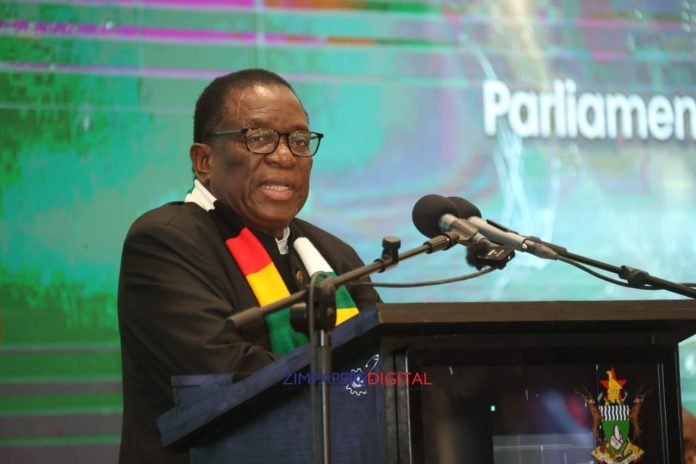

President Emmerson Mnangagwa has officially signed into law sweeping constitutional amendments that extend presidential and parliamentary terms from five to seven years, paving the way for his current tenure to continue until 2030. The new legislation also replaces Zimbabwe’s system of direct presidential elections with an electoral process conducted by Parliament.
The changes became law after Mnangagwa assented to the Constitution of Zimbabwe (Amendment) Act (No. 3), 2026, which was published in an Extraordinary Government Gazette on Tuesday as Act No. 6 of 2026.
The legislation cleared Parliament after the Senate approved it on June 24 by 75 votes to four. The National Assembly endorsed the Senate’s amendments on June 30, passing the bill by 226 votes to 41. The governing Zanu PF party and its allies, who command overwhelming majorities in both chambers, secured its passage.
Among the most significant reforms is the extension of the presidential term from five to seven years. As a result, Mnangagwa’s second and constitutionally final term, which was previously due to expire in 2028, will now run until 2030. Parliamentary terms have also been lengthened to seven years.
The amendments also overhaul the method of electing the president. Instead of a nationwide popular vote, future presidents will be chosen by Members of Parliament and Senators sitting jointly after every general election or whenever the office becomes vacant.
Under the revised constitutional provisions, a presidential candidate must obtain an absolute majority of valid votes cast by legislators. If no candidate achieves that threshold in the first round, a runoff election between the top two candidates will be held. The Zimbabwe Electoral Commission (ZEC) will oversee the voting process.
Anyone elected president through Parliament will be required to relinquish their parliamentary seat. Where the presidency falls vacant, a replacement must be elected within 30 days. During that interim period, Parliament will be prohibited from passing legislation introducing substantive policy changes.
The constitutional changes have attracted strong criticism from legal experts and opposition figures. Human rights lawyer Doug Coltart argued that the new provisions could allow a president elected by Parliament to begin a fresh seven-year term, creating the possibility of repeated renewals without returning to the electorate.
Coltart said the interpretation of the amendments would likely face legal challenges.
Constitution Defenders Forum leader Tendai Biti described the amendments as concentrating political authority in the hands of a small political elite. He argued that the reforms weaken democratic accountability by shifting power away from ordinary citizens and towards those capable of influencing internal party processes.
Former opposition legislator Fadzayi Mahere also condemned the amendments, describing their enactment as a major setback for Zimbabwe’s democracy.
The legislation further expands the Senate from 80 to 90 members. The additional 10 senators will be appointed directly by the president on the basis of their professional expertise and competencies following consultations with the National Assembly. Critics say the change increases executive influence over the upper house.
Another major reform transfers responsibility for voter registration and management of the national voters’ roll from the Zimbabwe Electoral Commission to the Registrar General through the introduction of a new Section 43A. Related amendments remove several of ZEC’s longstanding constitutional functions.
Electoral boundary delimitation will also be removed from ZEC and assigned to a newly established Delimitation Commission. The commission will be chaired by a serving or former Supreme Court judge, or another suitably qualified individual appointed after consultation with the Judicial Service Commission. It will also include five additional members with expertise in areas such as demography, public administration, cartography and representation from the National Council of Chiefs. The timeframe for completing constituency boundary reviews has been extended from six months to 18 months.
The judiciary will also undergo structural changes under the new law. A new office of Judge President of the Supreme Court has been created to oversee that court, while the Chief Justice remains head of the judiciary and continues to lead the Constitutional Court.
The amendments also set a minimum bench of five judges, in addition to the Chief Justice and Deputy Chief Justice, for Constitutional Court proceedings. The court is granted broader powers to hear appeals involving legal questions of general public importance where it grants leave to do so.
In another significant change, the public interview process previously used in judicial appointments has been abolished. The president will now appoint the Chief Justice, Deputy Chief Justice, the Judge Presidents and all other judges after consulting the Judicial Service Commission.